

Top Features to Look for in Defense-Ready Industrial Panel PCs
Buying an industrial panel PC for a defense application isn’t like purchasing IT equipment for a corporate office. The stakes are different. The environments are different. And the consequences of a hardware failure are in a completely different category.
Whether you’re a defense contractor spec’ing hardware for a new program, a base IT officer upgrading aging equipment, or a systems integrator building a rugged operator station, this guide covers the features that separate a defense-ready industrial panel PC from one that merely looks the part.
1. MIL-STD-810 Environmental Compliance
This is the baseline requirement for any serious defense application. MIL-STD-810H (the current revision) defines test methods for:
- High and low temperature operation and storage
- Temperature shock cycling
- Humidity and moisture resistance
- Vibration (multiple profiles)
- Mechanical shock
- Altitude and decompression
- Dust and sand resistance
- Rain and water immersion (certain profiles)
“A panel PC that’s been tested to MIL-STD-810 has survived a simulation of the worst environments your operators will ever encounter. That’s not marketing — it’s verifiable test data.”
Always request the actual test reports, not just a “meets MIL-STD-810” marketing claim.
2. MIL-STD-461 EMI/EMC Compliance
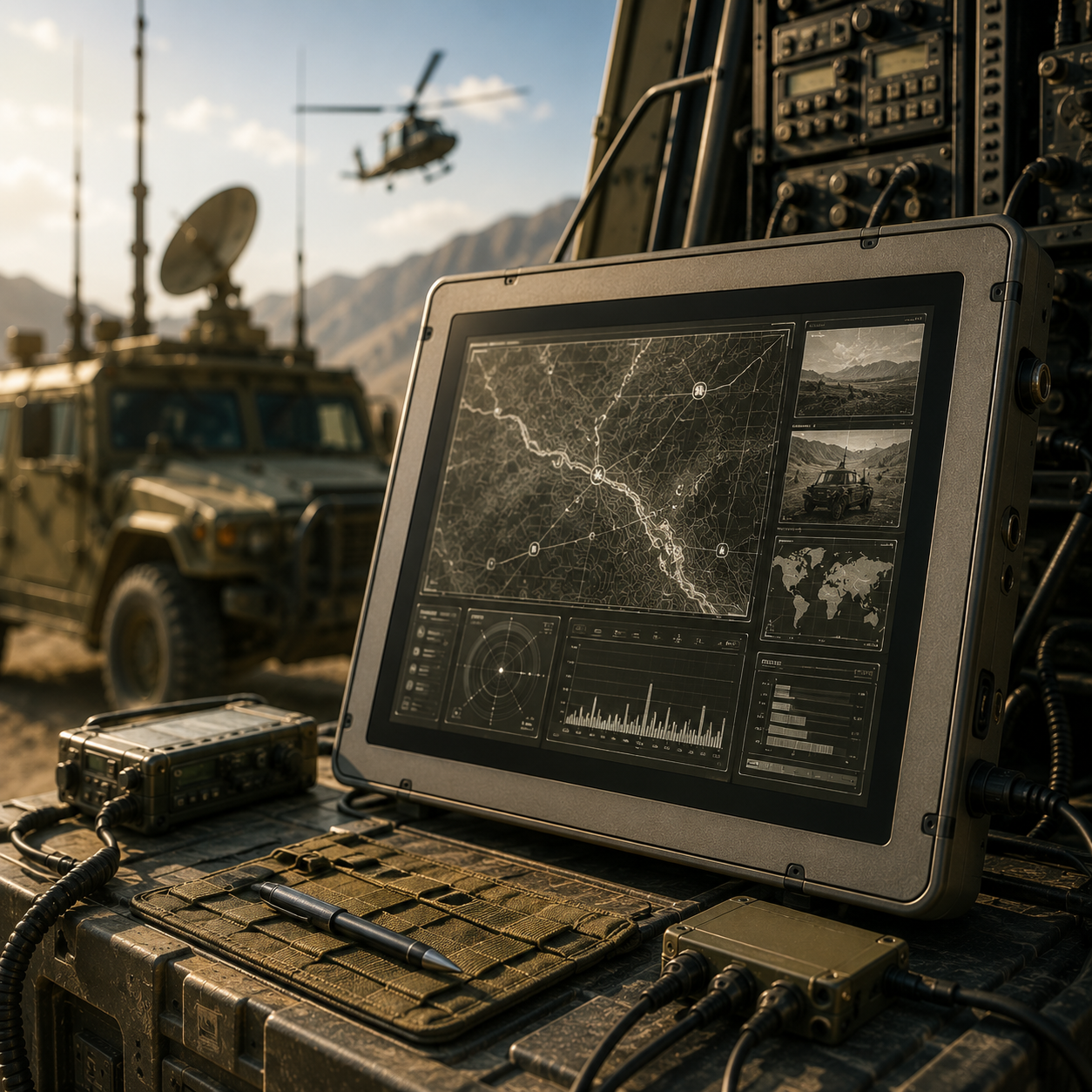
Electromagnetic compatibility is often overlooked until it causes a field problem. Defense environments are electrically noisy — radar systems, radio transmitters, jamming equipment, and power generation all create interference that can corrupt data, crash systems, or cause dangerous malfunctions.
MIL-STD-461G compliance ensures the panel PC:
- Doesn’t radiate interference that disrupts other equipment
- Is immune to interference from surrounding systems
- Meets conducted and radiated emission limits
3. Ingress Protection (IP) Rating
For most defense applications, IP65 is the minimum acceptable rating — fully sealed against dust and protected against water jets. Shipboard and amphibious applications may require IP67 or IP68.
4. Wide Operating Temperature Range
Commercial hardware typically operates from 0°C to 40°C. Defense environments routinely exceed both ends of that range. Look for panel PCs rated from at minimum -20°C to 60°C — and wider if your application involves arctic or extreme desert environments.
5. Fanless, Sealed Thermal Design
A fan is three things in a defense panel PC: a dust intake, a noise source, and a failure point. Premium defense-ready industrial panel PCs use aluminum chassis construction with thermally optimized internal layouts to conduct heat away from processors without moving parts.
6. Wide-Range DC Power Input
Defense vehicles and mobile platforms run on 12V or 24V vehicle power — with spikes, transients, and voltage sag during high-load events. A defense-grade panel PC should accept at minimum 9-36V DC wide-range input with built-in surge and reverse polarity protection.
7. Processing Power for Modern Defense Software
Running situational awareness software, encrypted communications, GIS mapping, and battle management applications simultaneously requires real computing muscle. Look for:
- Intel Core i5, i7, or i9 processors (current generation)
- 16GB to 64GB DDR4/DDR5 RAM options
- NVMe SSD storage (M.2 or 2.5″) for fast, shock-resistant storage
- Dedicated GPU options for graphics-intensive applications
8. I/O Flexibility for Legacy and Modern Systems
Defense systems integration almost always involves connecting to legacy hardware. A defense-ready industrial panel PC should offer:
- Multiple RS-232/422/485 serial ports
- Multiple GbE LAN ports (ideally with isolated ground)
- USB 3.x and USB-C
- PCIe expansion slots for custom I/O cards
- DisplayPort or HDMI for additional display outputs
9. Long Product Lifecycle and Guaranteed Availability
“Defense programs don’t end in two years. Your hardware supplier needs to commit to the same timeline.”
Look for vendors offering 5- to 10-year product lifecycle guarantees with documented parts supply chain management. This is often a formal procurement requirement for DoD contracts.
10. Certifications and Compliance Documentation
Procurement offices and prime contractors want paper. Your panel PC vendor should provide:
- MIL-STD test reports
- CE and FCC declarations
- RoHS compliance documentation
- ITAR compliance confirmation (for U.S.-origin requirements)
DITHD: Defense-Ready Industrial Panel PCs
DITHD supplies defense-ready industrial panel PCs that check every box on this list. From MIL-STD certifications to long lifecycle commitments, their rugged computing solutions are built for the demands of military and government procurement.
- Phone: 760-599-9225
- Email: sales@dithd.com
- Browse the lineup
- Contact DITHD
Frequently Asked Questions
What is the most important certification for a defense industrial panel PC?
- MIL-STD-810H for environmental durability and MIL-STD-461G for electromagnetic compatibility are the two non-negotiable certifications for serious defense applications.
Why does a defense panel PC need a wide DC power input range?
- Military vehicles and mobile platforms produce unstable power with voltage spikes and transients. Wide-range DC input (9-36V) ensures the system operates reliably without external power conditioning.
Where can I source defense-ready industrial panel PCs with full certification documentation?
- DITHD provides certified rugged panel PCs with full compliance documentation. Contact them at 760-599-9225.
Spec the right hardware from the start.
Talk to a DITHD specialist and get a defense-ready industrial panel PC built for your program’s exact requirements.

Leave a comment